15 March 2009

Living through the digital revolution

Clay Shirky says more or less everything that needs to be said about why newspapers are in trouble and what might replace them in the future. He concludes:

In craigslist’s gradual shift from ‘interesting if minor’ to ‘essential and transformative’, there is one possible answer to the question “If the old model is broken, what will work in its place?” The answer is: Nothing will work, but everything might. Now is the time for experiments, lots and lots of experiments, each of which will seem as minor at launch as craigslist did, as Wikipedia did, as octavo volumes did.

[...]

Society doesn’t need newspapers. What we need is journalism. For a century, the imperatives to strengthen journalism and to strengthen newspapers have been so tightly wound as to be indistinguishable. That’s been a fine accident to have, but when that accident stops, as it is stopping before our eyes, we’re going to need lots of other ways to strengthen journalism instead.

When we shift our attention from ’save newspapers’ to ’save society’, the imperative changes from ‘preserve the current institutions’ to ‘do whatever works.’ And what works today isn’t the same as what used to work.

[...]

For the next few decades, journalism will be made up of overlapping special cases. Many of these models will rely on amateurs as researchers and writers. Many of these models will rely on sponsorship or grants or endowments instead of revenues. Many of these models will rely on excitable 14 year olds distributing the results. Many of these models will fail. No one experiment is going to replace what we are now losing with the demise of news on paper, but over time, the collection of new experiments that do work might give us the reporting we need.

As Shirky so astutely points out, the economic reality of newspaper publishing is shifting beneath the feet of the industry. Probably today's newspapers can't dance nimbly enough to save themselves. And that shouldn't worry us very much. It's just that one crucial function of newspapers--namely, reporting--remains a pillar of democratic society. We don't need to care who does it, but we need to care passionately that it gets done.

17 February 2009

The economists have no clothes

Over at The Atlantic, Gregory Clark admits, rather refreshingly, that academic economists have no clothes.

The current recession has revealed the weaknesses in the structures of modern capitalism. But it also revealed as useless the mathematical contortions of academic economics. There is no totemic power.
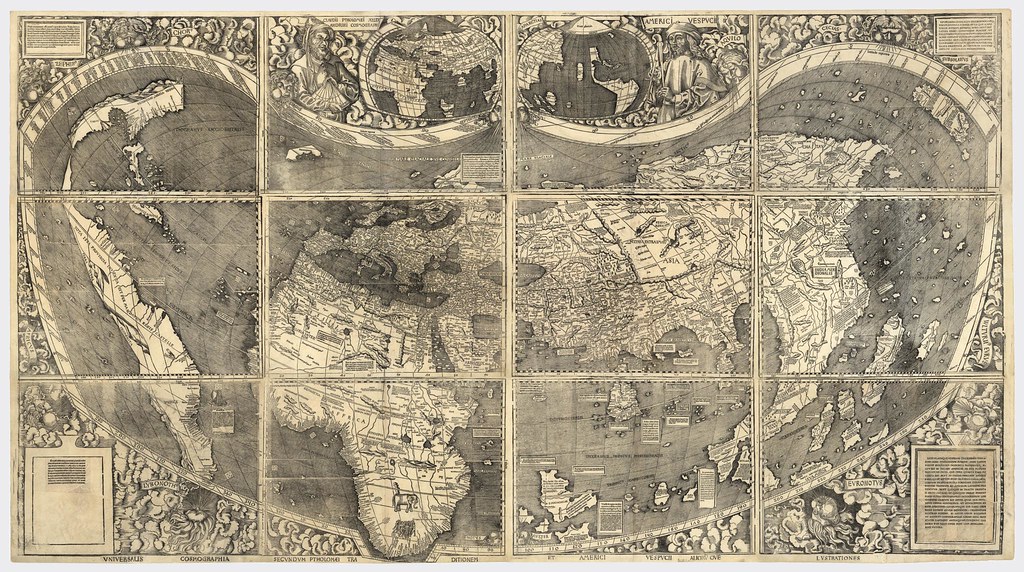
As a discipline, economics proposes models, which are by definition incomplete. That is, they exclude some details and highlight others. To think that economic theories actually describe reality--as opposed to offer an image of reality that is useful for some purposes--is to mistake the map for the world.
Waldesmüller, Martin - 1507 - Universalis Cosmographia
Ceci n'est pas le monde.

Further, the dismal science has all too often provided models whose validity is impossible to ascertain, since it has often built its theories on the basis of premises that are false prima facie. The point here is that, logically speaking, false premises do not yield false conclusions; rather, false premises render the truth values of an argument's conclusions indeterminate. It isn't that economic models are false, but rather that the falseness of their premises means that can know nothing with certainty about their conclusions. We can't say whether economic models are true, false, or some determinate mix of the two. Logically speaking, they're mere speculation, with the same logical status as wishful thinking.
Footprint Question Mark
You mean we came all this way and we don't even know if we're wrong?

For example, the theories of classical economics generally accept as axioms (i.e., they accept as true without argument) the following:
  1. All economic actors are rational.
  2. All economic actors have perfect information about the markets in which they act.
  3. All resources are scarce.
These are bad axioms, since they're obviously not true. As in, there's no doubt at all that these are false. Of course, not all branches of modern economics still accept these premises without qualification, but historically speaking these assumptions lie at the foundation of all economic thought. This is precisely the main reason I never studied economics in college. Who can take seriously a discipline that, wherever it ends up, begins with nonsense? While there's no doubt that the phenomena we think of as economic are intrinsically interesting, I remain skeptical that the formal discipline of economics has a great deal to offer beyond the obvious. As Clark notes:
The debate about the bank bailout, and the stimulus package, has all revolved around issues that are entirely at the level of Econ 1. What is the multiplier from government spending? Does government spending crowd out private spending? How quickly can you increase government spending? If you got a A in college in Econ 1 you are an expert in this debate: fully an equal of Summers and Geithner.
Common sense cloaked in jargon and equations. Even the economists' invisible clothes look rather shabby these days.

23 September 2008

The value of inconvenience

By almost any meaningful performance measurement, the U.S. economy in the 20th century performed better under Democratic administrations than under Republican ones. Reflecting on this seeming paradox, Christopher Carroll suggests that

perhaps the best explanation has to do with attitudes, not doctrines: Maybe capitalism works better when its excesses are restrained by skeptics than when true-believers are writing, interpreting, judging, and executing the rules of the game. (The Democrats are surely the more skeptical of our two parties).
Most would agree that restraining the excesses of almost anything counts as good sense, but this is only a preliminary step toward a bigger and more interesting idea:
Capitalism works better when it is being held accountable to some external standard than when left to its own devices.
The whole system works better when "held accountable to some external standard," when it is, in a word, constrained. Optimal performance, in other words, is the fruit of struggle. Make things too easy and performance declines.
Easy Living
Relaxed external standards? Check. Highlight reel material? Not so much.

Consider how effective coaches pull outstanding athletic performance from their players. Good coaches don't let their players do whatever they want, without accountability or oversight; they create rules and systems of accountability. A good soccer coach makes you use your weak foot in order to develop it. A good swimming coach pushes you to hold your breath longer. Optimal athletic performance depends upon the measured application of psychological and physiological pressure. (Go watch Gavin O'Connor's Miracle to see a dramatization of great coaching.) Good coaches don't remove limitations--they use them.

Or consider architectural and industrial design. The famous designer Charles Eames (yet another famous St. Louisan) once remarked:
Design depends largely on constraints.
We tend to believe that creativity is best served by removing constraints. If we could just somehow make the process of invention easier for the inventor, we imagine that she would be more inventive. But the opposite is usually true. People get creative--truly creative--when challenged to negotiate constraints. Budgets (within reason) push architects to develop new strategies to solve old problems. (The story of how the design of Seattle's new public library building developed is a great example.) The particularities of manufacturing processes push industrial designers to find solutions which challenge convention. (The story of the how the first commercially viable computer mouse was designed is a textbook example.) Constraints drive creativity.
Goldsworthy Boxed Tree
Artist Andy Goldsworthy creates astonishing ephemeral works using only the materials he finds on site during his wilderness hikes: creativity driven by constraint.

The same is true in business. Real innovation happens where someone discovers a new way to scratch an old itch, where someone thinks through a problem in a new way (even if it's simply a new application of an old technology). When we talk about innovation happening "at the edges" of a market or industry, what we mean is that innovation happens where business rubs up against constraints. (The "mainstream" of anything is where things flow smoothly, right?) We can't have innovation--and capitalism's greatest strength as an economic system is its powerful incentives for innovation--unless we have the right kind of rules and restrictions. (The question of "more" regulation versus "less" regulation is puerile. The kind of regulation matters more than the amount.) The free market, to put it pointedly, is only as free as its constraints force it to be.

Of course, constraints are damned inconvenient. And that's precisely the point. It's often--if not always--in response to inconveniences that people are most creative, most inventive, most innovative. And so we're led inevitably to the conclusion that inconveniences can be useful.
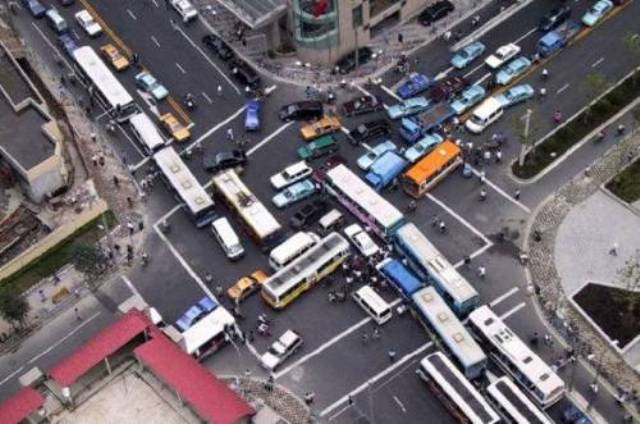
Gridlock
"Traffic lights are just the Man keeping us down! We will not be constrained!"

Some inconveniences, naturally, are more useful than others, but that hardly obviates the necessity of inconvenience for optimal performance. It's easy enough to see how inconveniencing others might be worthwhile, but it's one of the marks of emotional maturity to see the value of inconvenience for oneself. Politics--in the largest possible sense of the word--is only possible because we deliberately accept to be inconvenienced in certain ways (e.g., we don't simply use whichever car is closest, use guns to force our crushes to go out with us, or lynch elected officials from opposing parties). We recognize that our condition is collectively better when we all accept to be inconvenienced in certain ways. (Again, the kind of self-regulation matters more than the amount.)

Finding--and enforcing--the right kind of constraints is key to getting the most out of people, as innovators, as politicians, as artists, as designers, and even as citizens. We would all of us do well to remember that inconvenience--yes, even our own--often serves us much, much better than convenience.

10 July 2008

The first rule of student engagement

I'm in Québec City right now, attending a 5-week intensive program in French Language immersion. One of the options I've chosen is an introductory survey course on Quebecoise literature. There are only a dozen students in the course, so the teacher said she'd like to run the class more as a seminar and less as a lecture. Which sounded great--but it turns out our teacher doesn't seem to know how to run a discussion (not an uncommon failing among teachers). She doesn't seem to grasp the first rule of student engagement--actually, the first of intellectual engagement in general. And that rule is this:

People engage with ideas on the basis of what they already know.

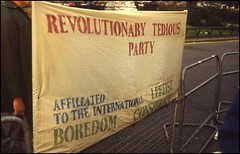
The technicalities of revolution are, as everyone who attended the party found out, pretty damn tedious.
(Revolutionary Tedious Party, originally uploaded by abitnice)


This rule has two important practical corollaries:

  1. Discussions turn on questions that everyone can answer. Domains where students are largely ignorant offer no footholds for students to establish a stance and launch into a discussion. If you start talking about what you know well, but what your students don't know at all, they won't respond for the simple reason that you're the obvious authority and what you say goes. If you base the discussion in a domain where the students have some knowledge (their own opinions are painfully dependable as a point of departure), you'll be able to introduce the topics you want to cover without killing the conversation.
  2. Technicalities kill engagement. Technicalities are inevitably the province of specialists. If you're talking about technicalities, you'd better be talking to another specialist (or someone who aspires to be a specialist). If you're not, guaranteed you're boring people in a way that makes them just want to break something.
Engagement is the foundation of every learning experience. Engagement can only happen when people take what they already know and either reinterpret it or connect it with new knowledge.

28 March 2008

A cinema whose house is always full

As promised, I'm getting around to posting my better business ideas. Yes, yes. I'm sure your breath has been bated.

INTRO
Think of your favorite movie. Now imagine the ideal environment in which to watch it. Do you see yourself alone, in your underwear, in your own bedroom, late at night, watching your favorite movie on your computer monitor? Unless you're one of those rare individuals willing to argue the artistic and cultural merits of porn, it's not likely.
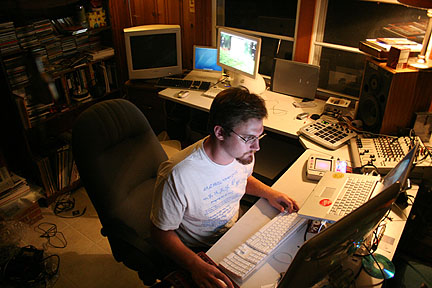
NOT the Future Cinema
The future of porn? Maybe. The future of cinema? Don't count on it.

Probably you're thinking of a dark room with a huge screen and comfortable chairs. And, almost certainly, other people. Although the advent of forums like YouTube has fomented whole new genres of minimalist movies (e.g., machinima, video how-tos, porn vlogs, and even as yet un(sound)bitten political speeches), our thirst for full-length feature films appears unslaked. And we still prefer viewing them, when possible, in the company of other viewers. As an art form, film descends from theater, and the social dimension of theater is irreducible and ineradicable. Part of the meaning of watching theater--and therefore part of the meaning of watching films--is watching them as part of group.

Viscerally, we know this is true. Funny movies are funnier when viewed in a packed cinema. Scary movies are scarier. Exciting movies are more exciting. The whole experience of watching a film is intensified and improved when the house is full.
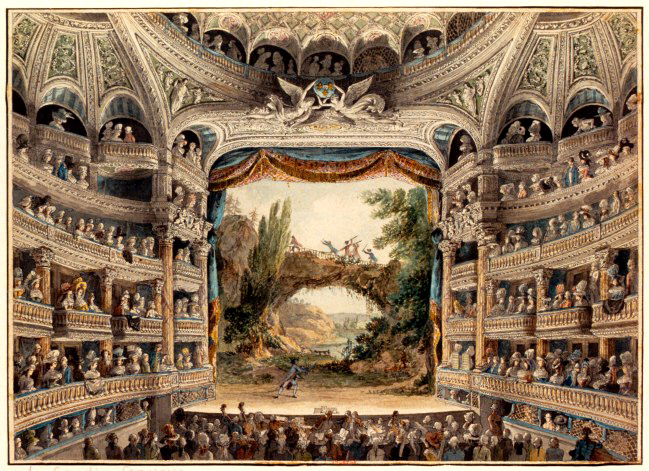
Meunier, A. - 18th C. - Paris_ Comedie Francaise
In a sense, "audience" is a role--a role it sucks to have to play by yourself.

OPPORTUNITY
Most current thinking about about how people are going to consume movies in the future, even the freshest, can be divided into models based on how people consume live theater on the one hand and how people consume internet pornography on the other. (There are some non-stupid "innovations" in the works which try to make the most of the cinema space, but they have little to do with the movie-going experience per se.) The theater model can't seem to get past the fact that plays are performances while films are recordings of performances--that is, they're what we call media. The porn model can't seem to get past the fact that watching anything except porn by yourself isn't nearly as much fun as watching it as part of an audience.

The most important development in the movie business during the past 20 years isn't--with all due respect to Peter Jackson and his fanboys--CGI, but the megaplex:

The improved viewing experience and the ability to let consumers watch whatever movie they wanted almost whenever they wanted brought more people through the door and bulked up Hollywood's grosses.
I love this conceit--that access to 20 or 30 screens has allowed consumer to "watch whatever movie they wanted almost whenever they wanted." Whatever movie I want? Give me a break. And what about TV series, animated shorts, foreign releases, etc. etc. etc.? And rental stores? There are good reasons why they're dying out.
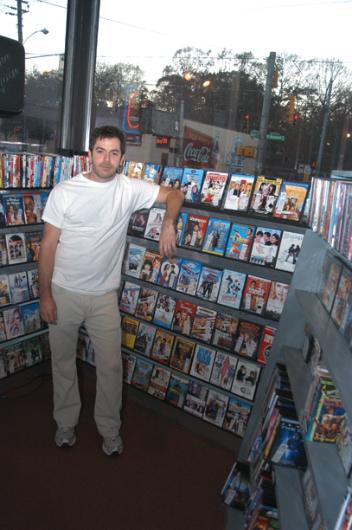
Local Video Store
"Um.. Bollywood? The Thunderbirds? Fullmetal Alchemist? Le Dîner de cons? Nah, we don't got any of that. But, dude, have you seen The Transformers?"

Megaplexes offer an order of magnitude more choice than the 3-screen movie house; your average rental store (which carries some 3,000 titles according to Chris Andersen) ups the choice by two more orders of magnitude. And then Netflix and company bump that up to 60,000+ titles--another order of magnitude plus a doubling thrown in for good measure. No doubt that 30 screens offers a lot of choice, but it's still the film industry and the theater managers who decide what's on the menu. Time to break out.

THE IDEA
The challenge, I would argue, is to get The Long Tail of screenable media (i.e., movies, TV, video games, and a bunch of stuff I'm sure I'm missing) to interface elegantly with the social theater experience.

The Setting. So, imagine an urban megaplex which offers 30 screens of varying sizes--from the 300-person stadium to the 15-person black box. (I'm picking 15 as the minimum capacity because, in my experience anyways, 12 is the magic number where dinner party tips and becomes a house party.) However we manage it, our megaplex is technically capable of showing anything that's currently out on DVD on any of its screens. (I see two basic possibilities here: either (1) allow the viewers to bring their own media--you're just a screen and seat provider; or (2) go digital--maybe make ISO images of every DVD you can get your hands on, or an equivalent. I like (2) better for a variety of reasons, but (1) might be the place to start while the IP agreements get hammered out.)

Architecturally, the lobby resembles a cafe more than a cattle yard. Picture a large space subtly divided by differences in floor height, floor coloring, lighting, etc. in order to create a cluster of distinct, yet interconnected spaces, each of which feels somewhat enclosed and therefore intimate. The idea is to provide environmental level support the social dimension of consuming screenable media. Film clubs, groups of friends, and/or couples can use this space to nosh and chat before and after movies.

The Website. The website of our megaplex looks more like a social networking website than a tarted-up broadsheet for the very simply reason that it is a social networking site. The website is the platform which our megaplex uses to decide--on a rolling, ongoing basis--what it's going to show on each of its screens. Website members "vote" for a particular title and a particular time-slot by prepurchasing tickets to those titles at those times. (Credit card authorization--not charged until movie is shown.) The most popular title for any given time-slot is shown in the biggest theater, the second most popular in the second biggest screen, and so on. Titles are "locked in" 48 hours in advance in order to allow everyone to plan their schedules and casual viewers to pick what they want.

One interesting consequence of this system is that it becomes possible to distribute various screens over several different physical locations within a city. Not too many different locations, or people would get confused. But a single web system could link together a handful of physical clusters of screens into a single movie selection and viewing system, effectively allowing our megaplex to consume urban real estate much more efficiently. We can therefore offer 100 screens' worth of choice without thereby incurring a need for a gargantuan, unbroken chunk of real estate. In fact, precisely the opposite. The more geographically concentrated our demand (the more "urban"), the more screens we can offer. And further, since every theater is filled to capacity (or as close as we can get) every time, we optimize our use of square footage even further.

Show Me the Money. Our megaplex will pass profits back to those who own the rights to the media on a per-seat-sold basis rather than a per-showing basis. This has several consequences.

First, pricing for the viewer is dynamic. The more "votes" a suggested title-and-time gets, the cheaper the tickets. This displaces some of the responsibility (and risk!) of promoting a particular title-and-time onto its supporters. A film club working its way through all of Humphrey Bogart's films, for example, will not only form the core of the audience which views those films--they'll also promote those title-and-times to everyone else. Take this line of thinking to its logical conclusion, and you've got individual promoters buying out entire screens and promoting film events (say, a Star Wars-a-thon) on their own. The promoters shoulder the risk of promotion; the audience gets a full house experience; and our megaplex gets a locked-in profit on an optimized use of cinema square footage. Every title which gets shown in our megaplex has, before it shows, demonstrated that it can command such-and-such level of committed demand.

Second, pricing between our megaplex and media rights owners is negotiable on a title-by-title basis--even on a showing-by-showing basis--because our megaplex can show exactly how many seats are sold for each title. Structurally, such a system will favor older titles (whose production costs have already been either recouped or written off), niche titles (which capture focused, sustained affection), and less publicized titles (which have fewer advertising costs built into their financing model). Basically, although our megaplex is perfectly capable of competing with "normal" theaters when it comes to blockbusters, it's capable of making gold out the vast libraries of screenable media currently lying around in our culture.

And third, this system really opens up the possibilities for using a cinema-like space in creative ways. Business presentations? Naturally. Ungodly-huge-screen Super Smash Bros. Brawl parties? No problem. Anime marathons? Duh. In a way, this model is a bit like McDonald's:
The brilliance behind Harry Sonnenborne’s model [for McDonald's] was to sell real estate and not hamburgers. His suggestion was to purchase or lease the land on which all the McDonald’s restaurants were built on. Franchisees would then pay the company either a monthly rent amount or a percentage of their gross sales, whichever amount was greater.
The idea isn't to sell movies (which today's theaters can't do, so they sell outrageously priced corn syrup instead) , it's to rent square footage, facilities, and equipment to those in a position to use those resources to their utmost. Why be a lousy movie promoter or a gouging snack-food vendor when you can be a fantastic screenable media landlord? Let the watchers be the deciders, because those who decide what to show bear the risk for promoting it.

AFTERWORD
There are plenty of holes here, so please, comment away.

06 March 2008

The meaning of business

Lately, I've been mulling over a comment made by my uncle--who has the reputation in the family of being a super savvy investor--to the effect that it doesn't matter what a business does per se, so long as it turns a profit. I've argued before on this blog that my uncle's position unfairly impoverishes the concept of value. I've even gestured (crudely) in a few directions which might help us to enrich our concept of value.

Over at The Bastiat Society Blog, however, Ben Rast has a post entitled Business as Creative Act, which takes the first few steps down what I think is the brightest path toward a full and mature understanding of what business is (and why my uncle is mistaken). Simply put:

Business, as a creative act, draws on the very same strengths and suffers the same weaknesses as the creative act in art. They are more alike than dissimilar.
By "creative act," Rast means to emphasize entrepreneurship particularly:
We can illustrate just how much artistic creativity and business creativity have in common with the following paragraph of advice to writers, taken from an interview of William Faulkner published in the Paris Review in 1956:

"Let the writer take up surgery or bricklaying if he is interested in technique. There is no mechanical way to get the writing done, no shortcut. The young writer would be a fool to follow a theory. Teach yourself by your own mistakes; people learn only by error. The good artist believes that nobody is good enough to give him advice. He has supreme vanity. No matter how much he admires the old writer, he wants to beat him."

Now, notice how well it works as advice to entrepreneurs -- those troublesome dreamers and innovators in business -- with a few strategic substitutions.

"Let the entrepreneur take up surgery or bricklaying if he is interested in technique. There is no mechanical way to get business done, no shortcut. The young entrepreneur would be a fool to follow a theory. Teach yourself by your own mistakes; people learn only by error. The good entrepreneur believes that nobody is good enough to give him advice. He has supreme vanity. No matter how much he admires the old business, he wants to beat it."
Rast is astute to catch this similarity. People who launch new enterprises resemble artists in their drive to make something new, to add an original trope to the poem of humanity. But it's obvious, in a sense, that entrepreneurs are creators. What's not so obvious is that all productive activity (in the economic sense)--that is, all business activity--is creative as well.

To put it succinctly, human creativity is coextensive with human endeavor. Wherever people get stuff done, there people come up with new ways to think, do, and make. It doesn't matter what you call the end product--good, service, artwork--productive human activity demands creativity for the very simply reason that every object humans make with intention and every action humans do with intention bears the stamp, as it were, of the intention that brought it into being.

Aristotle identified four causes which obtain in the world: the material, the formal, the efficient, and the so-called final cause. It's the last one which concerns us here. The
final cause explains the cause of something in terms of its conceived end, or the purpose why it is made. According to Aristotle, [the] final cause is “the end (telos), that for the sake of which a thing is done.”
Every good is made and every service performed for the sake of something else--specifically, they're made and performed for the sake of the customer's good. That's why we call them "goods," right? Yes, yes, the producer produces goods in order to get paid, and the service provider serves in order to get paid, but they only get paid if someone recognizes the value of their goods and services. (And this objection is weak, since money is only and always a means to an end. "To get paid" can never be a final cause for making or doing something for the simple reason that money always points beyond itself to another end--one always exchanges the money on something else. It is not, simply put, final.)

Because goods and services are self-evidently intended to do someone some good (otherwise who would buy them?), we can say that economically productive activity is not only a functional activity, but is additionally an expressive activity--that is, it means something. In particular, it speaks to a vision of the good in general and the customer's good in particular. Even further, each good produced and each service provided changes the world; each good and each service brings into being a new state of affairs which must be presumed to be better than had the good been left unmade, the service undone (again, otherwise who would buy them?).

From this line of thinking two absurdly important conclusions follow:
  1. Businesses really do change the world--so they'd better get it right. The presumption of "providing value," of making or doing something "good," is built into the very possibility of business. If a business doesn't add value--that is, if it doesn't make the world a better place--then it has no business being in business. It seems almost too obvious to need saying, but... businesses may be judged by the same standard as every other human endeavor, and that standard is whether or not the business's making and/or doing makes the world a better place.
  2. Investors are to companies what patrons are to artists--so they'd better get it right. Warren Buffet famously advises investors to buy shares of a company only if they'd be willing to buy the whole company. I'll take Mr. Buffet one step further. You should buy shares of a company only if you'd be willing to be that company's sole customer--like an artist's patron, buying, owning, and enjoying responsibility for that company's entire output. Just as being a shareholder means being wholly and individually responsible for (and dependent upon) a company's entire financial performance, so being a shareholder means being wholly and individually responsible for (and dependent upon) a company's entire, world-changing making and doing. Just like a patron, you've put money down so that the companies you own can make what they make, do what they do. You enjoy the financial fruit of the shares you own for the single, simple reason that the companies you own get paid for changing the world, and the world they're making and enacting is the world we all live in--the world our children are growing up in.

07 February 2008

18 inspirations for educators and social entrepreneurs

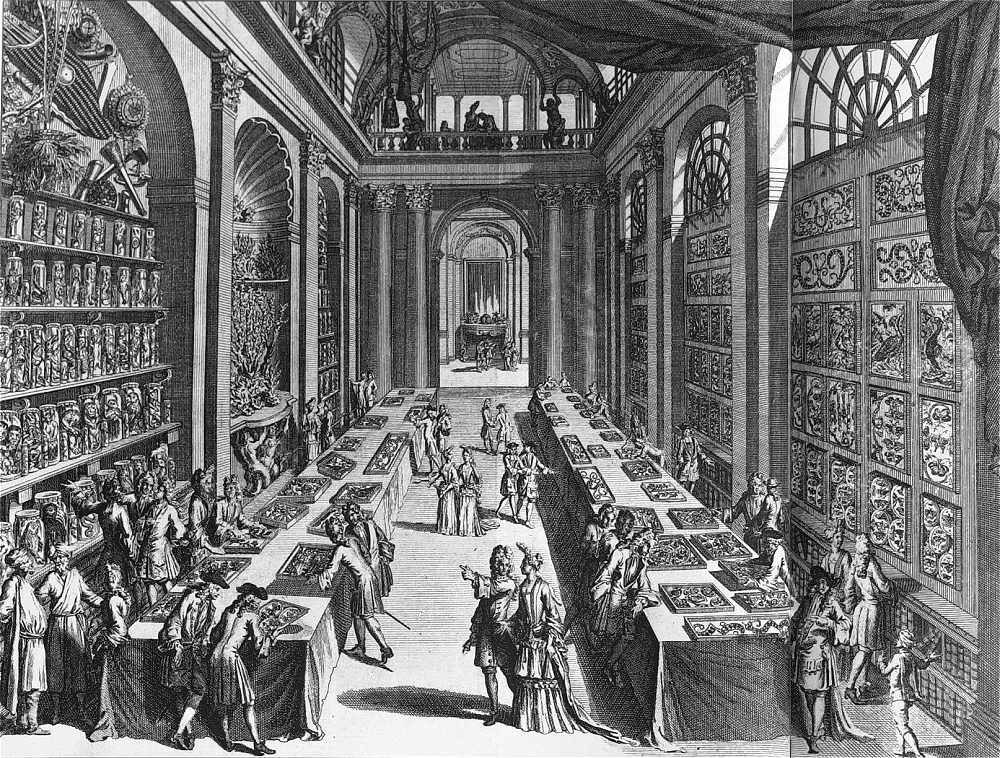
Some people collect stamps. Others collect curiosities. I collect (among other things) pedagogical models, theories of learning, writings on education, and great educators. Someday I'll boil it all down and give you just the bullion, just the essence. But I need more time. My collection is far from a complete 7-course chowdown; heck, it won't do anything more than whet your appetite... but at least that means I've probably gotten to hors d'oeuvre status.
Vincent, Levin (1658-1727) - 1719 - Elenchus tabularum...1
"My! You have such an interesting collection of... um... what are these, exactly?"

Model Institutions, Organizations, Etc.

  1. Danish Folkeuniversitetet ("Folk High Schools"). The keystone of Danish national and democratic identity. One of the great triumphs of modern liberalism (in the strict sense of the term).
  2. Hampshire College. The Un-Ivy League. Classes, but no core curriculum. Written evaluations, but no grades. Books, but no teacher's dirty looks.
  3. The Nueva Escuela ("New School"). A program aimed at the developing world which supports schools as agents of positive social change. Focuses on education which is "active, participatory, cooperative, child-centered, and life-relevant." The story is that the founder asked every Nobel laureate she could get her hands on what kind of school they wished they had attended.
  4. The KaosPilots (of course). A new kind of business school, aimed at at the fourth sector.
  5. The Acton MBA (of course). Business school on steroids, which aims to produce entrepreneurs rather than managers.
  6. Y Combinator. Although it claims to be a new kind of venture capital firm, it's really an intense education in how to be a world-class tech entrepreneur.
  7. Gever Tully's Tinkering School. Let your kids do dangerous things, otherwise they'll never learn how to handle dangerous things. When I put it that way, it's obvious, right?
Writings Worth Reading
  1. "On Education." Ralph Waldo Emerson's seminal essay on the subject, in which he argues that "the secret of education lies in respecting the pupil."
  2. "Talks with Teachers." Brilliant lectures on teaching by eminent 19th century American psychologist and philosopher William James.
  3. "Complicity." Online journal on complexity (read: chaos theory) and education. Be warned: this journal has a rather pointy head.
  4. Infinite Thinking Machine. A blog providing coverage of innovation in education.
Models, Movements, and Technologies
  1. Ignatius of Loyola's Spiritual Exercises, by which I mean more than simply the book by the same name. The exercises are a masterfully conceived and carefully refined ethical technique (read: a practice by which one acquires a particular character).
  2. Unschooling. Let the child set the educational agenda; teaching consists principally in encouraging and enabling.
  3. Moodle. A widely used open source course course management system.
Educators to Emulate
  1. Socrates. The gadfly of great Athens.
  2. Johan Amos Comenius, the Czech (Moravian, to be precise) "Copernicus of education."
  3. Nikolai Frederik Severin Grundtvig, founder of the Danish Folk High School.
  4. Amos Bronson Alcott, the original Transcendentalist, and the greatest teacher [.pdf] in U.S. history.

11 January 2008

It's getting hot in here...

...so take off all your clothes? No, no, no, silly. Your mind is clearly elsewhere. Let's try again.

It's getting got in here, so harvest all of that wasted body heat and pipe it over to the nearest office building. (My thanks to LS for bringing the story to my attention.) Come again? They're going to use body heat to keep buildings warm? Isn't that just a bit... brilliant? If the whole scheme sounds too savvy to be true, that's only because it's Swedish.

A Swedish company plans to harness the body heat generated by thousands of commuters scrambling to catch their trains at Stockholm's main railway station and use it for heating a nearby office building.
I can avow, on the basis of personal experience, that the Swedish think differently. Which is why I think the current rail-station plan is just the tip of the iceberg.
Dance Club
Trust the Swedes to see that awkward singles scenes are one of our great untapped reservoirs of renewable energy.

10 January 2008

From this spark, fire

At the behest of some smart people I recently had the good fortune to meet, I'm going to start using this blog to post concept sketches for some of my business ideas. (All such posts will be filed under--i.e., tagged as--"JPs Biz Ideas") I'm posting ideas in the spirit of cooperative thinking; I hope that my thoughts inspire reflection, conversation, and maybe even action. Just remember that this is thinking toward getting something started. Whatever you have which will help move the conversation forward--thoughts, criticisms, stories, whatever--I'm eager to hear from you.

For those worried that I'm only sharing the chaff, I can understand where you're coming from, but I'm not going to be driven by my fear. What you'll see here will only be the cream. And further, just because an idea happens to sashay in front of my mind's eye doesn't mean I'll post it; only those which my satisfy my rather demanding inner impresario will be offered up for your delectation. In other words, only the truly interesting ideas will find themselves in pixels.

Enjoy! And please add to the conversation. Comments and contacts welcome!

03 January 2008

7 simple litmus tests for innovativeness

Several weeks ago, when I was complaining about the first round Innovation Challenge results for 2007, I promised that I would get around to providing a few simple litmus tests for determining whether or not an idea is truly innovative. Eh, voilà!

These tests have been designed with three purposes in mind. First, these tests specifically aim to refine the line between the categories of conventional and innovative. Once an evaluator (whether in situ or post facto) has performed her first-order triage of proposals into probably conventional, probably innovative, and borderline, these tests should help her to shake a few proposals off of the fence before she proceeds to her in-depth review.

Second, these tests provide points of departure for a structured approach to evaluating the relative merits of one proposal vis-à-vis another. My catalog of traits certainly fails to exhaust the concept of innovativeness, but it at least offers a starting point for further thought and discussion. (Please let me know if you think of a trait I've missed.) If, for example, you're trying to decide which of two possible proposals should go forward, these tests should springboard the team into a focused dialog.

And third, these tests provide innovators with a set of spot checks which are so simple and so fast that they can be applied on the fly, as the innovation process unfolds. Because the tests are rational in their structure, they can help a team build a shared understanding of what a genuinely innovative proposal would look and feel like. But because the tests rely explicitly and entirely on subjective interpretation, they can tolerate extremely intuitive applications. These tests have designed to act as guides--not straitjackets.
Litmus Paper
Would the Innovation Challenge judges of C.E. 1301 have recognized Arnaldus de Villa Nova's litmus paper for the miracle innovation it is?

Each of the following tests is constructed as a proposition which purports to highlight a particular trait inherent to innovativeness. The evaluator considers the idea or proposal in question in light of the proposition and decides to what extent the proposition applies. A positive response to the (i.e., "yes," "good," "true," or the like) indicates that the idea or proposal in question is testing positive for innovativeness. Comments are enclosed in square brackets.

  1. Fresh. "Although I grasp the proposal in its broad outline, parts of it seem strange and/or unfamiliar." [You know you're getting close to a fresh opportunity when things stop feeling normal and familiar.]
  2. Simple. "The value proposition (for the customer) is so simple that not only do I understand it, I can easily explain it to others." [Implementation can be complex, but the value proposition must be simple, because people won't buy what they don't understand.]
  3. Bold. "The first thing I think when looking at the proposal is, 'Too challenging!' 'Too risky!' or maybe even 'Impossible!'" [Challenge is what brings out the best in people and organizations; risk is the harbinger of reward; and the impossible is only another name for the as-yet untried.]
  4. Trailblazing. "If someone were to implement the proposal, I know that competitors would immediately attempt to copy it." [Fear of being copied is, in practice, equivalent to fear of being the leader.]
  5. Obvious. "Now that I've read the proposal, the idea seems completely obvious." [Great innovations are obvious, but not cliché--that is, they're ideas which many people could have implemented, but which no one has yet implemented.]
  6. Clever. "I wish I had thought of that." [Whatever inversion, riposte, or twist of thinking makes the proposal hum should inspire admiration.]
  7. Feasible. "In a close-to-perfect world, the proposal ought to be feasible." [For early-stage innovation, the appropriate test is putative feasibility. The real-world feasibility of an idea is not truly tested until a competent team commits to trying to implement it. An overweening demand for "practicality" will kill any proposal which requires an unconventional implementation strategy.]
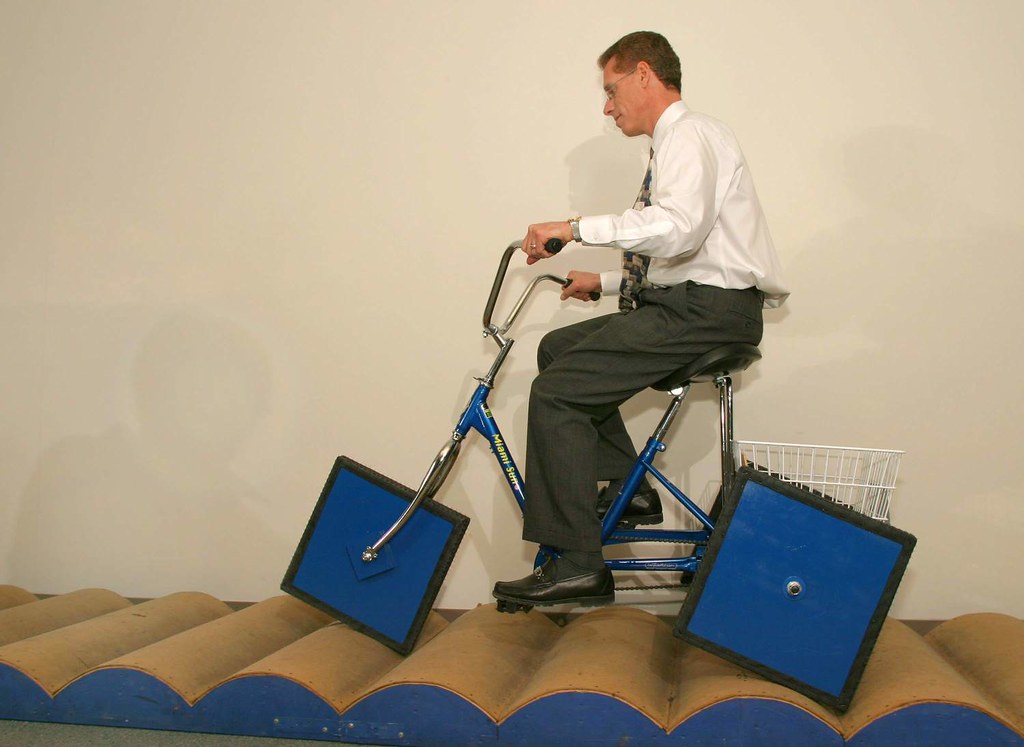
Square Wheel Bicycle
Are you so certain this is foolish? As it turns out, he didn't reinvent the wheel--he reinvented the road.

02 January 2008

Disorganize the schools!

The NYT covers the--gasp!--new trend of tutoring students (mostly boys) who seem to be having trouble in school. OK, OK, it's not the tutoring itself which is interesting. We've known for some time that tutoring is among the most successful of teaching methods. It's the fact that the tutors aren't teaching subjects, they're teaching habits. In other words, ethical tutoring.

If you want to get 'em educated, you first gotta' get 'em organized.
(Photo by Jim Wilson for the New York Times)

As per their standard operating procedure, the NYT adds zero content to and only a confused, watery viewpoint on the conversation. (When will they stop "reporting" and start giving us the story?) We've known for some time that girls outperform boys in almost every subject until puberty hits, at which point boys edge ahead in math and science. But why? And what to do about it?

The NYT frames the problem as one of organizational habits--which is curious because it focuses not on the problem, but on the (stopgap) solution. Providing boys with better organizational skills will undoubtedly help them do better in school. But doesn't this beg the question of why schools demand that children be "well-organized" in order to receive an education? Why should high-school boys need to develop bureaucratic skills and habits in order to learn? After all, the world itself wasn't color-coded the last time I checked.
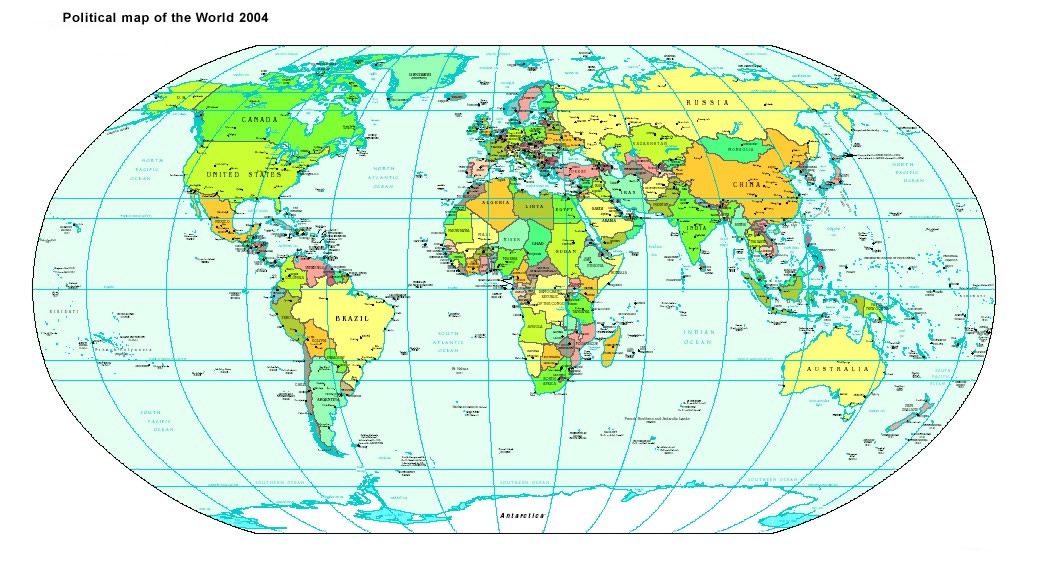
World Political Map 2004
A classic case of mistaking your map of the world for the world itself.

Too, the culture's perception of schooling has changed. I believe that parents used to be more focused on the education itself--what the child was learning, how s/he was doing in class, etc. There was a sense that the learning itself was the primary propellant provided by schools to children aimed at moving up in the world. Nowadays there's a great deal more focus on getting the certification at the end. It's the paper that matters--not the process. Especially with No Child Left Behind [free registration required], our focus become fixed on making the grade, and the means seem to matter little.

On top of our intense focus on the finish line, we still teach using methods which we know (and have known for years) don't work all that well. Is it any surprise that energetic, independent students should rapidly come to the conclusion that school isn't worth their time? Why not simply cheat, or cram for the test? And why worry at all, since that silly certificate isn't worth much any more unless you've got the right parents in any case?

Ultimately, it isn't boys who are less organized, it's our pedagogy (and indeed every institutional activity in our culture) which has become more rigidly organized. Turning in your not-very-interesting and not-at-all-important homework on time isn't equivalent to responsibility. It's just punching in. People who focus intensely on thing they themselves find trivial and meaningless are usually pretty unhappy. And no surprise there either.

27 December 2007

The myth of "passive income"

A friend of mine, JD, who used to work as a developer in New England, tells me that there's a new board game which is "sweeping the country." The game: Cashflow 101. The object of the game: become wealthy by mastering the art of investing. The game's designer (or perhaps just endorser): Robert Kiyosaki of Rich Dad, Poor Dad fame.

After reading his Yahoo! Finance column a few times, I've come to conclusion that Kiyosaki is a financial charlatan (which means that I refuse to drive traffic his way by linking to his stuff directly). In a nutshell, Kiyosaki's financial advice boils down to "Choose to be wealthy." I'm not kidding. His is the worst kind of quasi-libertarian snowjob, since if you pay for any of his motivational products or services, but don't get rich, why, it must be that you just haven't "really committed yourself" to being wealthy. If you're poor, it's your fault. You just haven't really, in your heart of hearts, chosen to be rich.
Poverty
"As you can see, my heart of hearts loves poverty more than I do."

While it's true that the acquisition of wealth can be a very subtle art, it's an open secret that (in the US, at least) the most simple, most direct, and by far most common strategy for getting rich is to have wealthy parents. But this is all really an aside. What I really want to discuss is the folly underlying Kiyosaki's game and the worldview it reflects.

In Cashflow 101, each player begins with a randomly selected income-expense profile--a job and a bunch of expenses. After that,

There are two stages to the game. In the first, "the rat race", the player aims to raise his or her character's passive income level to where it exceeds the character's expenses. The winner is determined in the second stage, "the fast track". To win, a player must get his or her character to buy their "dream" or accumulate an additional $50,000 in monthly cash flow.
The whole thing revolves around this mysterious concept of passive income.
Little Pig Came to Me
He just followed me home. Seriously. So... can I keep him?

Aaron Maxwell has written a pretty good beginner's guide to Cashflow 101, which explains that
[p]assive income is income that comes in with little or no additional effort on your part. If you have royalties from a book, income from a rental property you own, or stock that pays dividends each quarter, you have passive income.
Maxwell immediately goes on the qualify that definition:
Sometimes you'll have to do SOME work - if that rental house develops a leaky roof, you'd better have it fixed if you want to continue collecting rent! The difference is that for a "normal" job, you have to invest your time continually to keep receiving income, and if you work half as much, your income immediately goes down by half or more. With passive income, after you do some initial work up front, you have an income stream that continues with little or no time on your part to maintain it.
And there's the rub. Passive income isn't genuinely passive in the sense that it requires no effort. It's simply that compensation isn't immediately correlated to effort. Passive income doesn't require endless, futile labor to sustain it. Rather passive income represents one flow within a relationship of ownership--and in the opposite direction flows responsibility. We receive passive income from assets for whose condition and behavior we are liable.

Calling the income passive is misleading, because it implies that such income arrives not simply without--or with minimal--effort, but with minimal worry as well. But ask any landlord--you're essentially paid to worry about stuff. Whatever the gods of pop music claim to the contrary, tenants do not call Ghostbusters first. Especially when the heat goes out. First, they call the landlord. Then, they call their lawyers.
Ghostbusters Logo
I ain't afraid o' no tenant.

Responsibility implies liability. Although rental property income provides the most stark example, other kinds of passive income also admit of analogous forms of responsibility. In exchange for book royalties, the author remains responsible for what he's written. In exchange for stock dividends, the owner becomes responsible for the behavior of the company whose shares she owns. (Warren Buffett famously advocates treating the purchase of stock as equivalent to the purchase of the entire company.)

The point here is that wealth, because it depends upon ownership, entails responsibility and liability in direct proportion. There's no such thing as truly passive income, and anyone who thinks she wants to be rich should be warned that Easy Street is the main thoroughfare in Neverland. Wealth is a sacred social trust, not a ticket to heedless self-indulgence. It is most certainly possible to enjoys the fruits of responsibility, but only for so long as and to the degree that one proves willing and able to bear its weight.
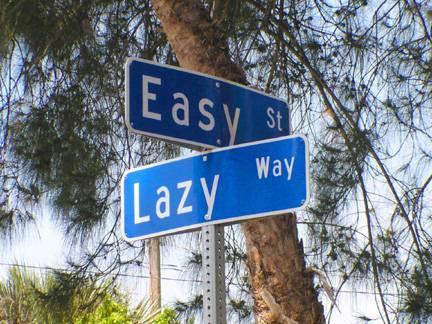
Easy and Lazy
We have a word for those who take the lazy way to easy street, and it ain't flattering.

24 December 2007

Knowing what you know

When I found Langdon Morris's book on innovation which boasts an epigram from Aristotle's Nicomachean Ethics, I was understandably excited. "Which passage from Aristotle did he choose?" you ask. Well, he chose:

Excellence is an art won by training and habituation. We are what we repeatedly do. Excellence, then, is not an act but a habit.
Which is an awesome quote, except that it doesn't belong to Aristotle. As a one-time teacher of the Nicomachean Ethics, I can vouch that this quote accurately sums up Aristotle's position on excellence. But when I went looking for the precise provenance of the quote, I discovered that (according to Wikiquote, at least) while the meaning does indeed belong to Aristotle, the specific words flowed from another's pen. Apparently, the above quote is Will Durant's summation of Aristotle's position in Book I of the Nicomachean Ethics. Since the quote remains a clear, concise, accurate summation--in fact, it's probably better than anything Aristotle wrote himself--we'll keep it.

I expect that Mr. Langdon's ethically sensitive parsing of the innovation process will yield a number of worthwhile insights, but for now I just want to cover one. His definition of knowledge and its implied definition of learning. Definitions appeal to my inner philosopher, and smart definitions are what make the world make sense. Too, the subject is, I think, central to the whole constellation of fields covered by this blog; loyal readers will recall that this blog was launched with a post on knowledge and learning.

Langdon's subtle and sophisticated definition of knowledge (found on p. 61 of the .pdf), boils down to the following:
Knowledge is concerned with "how," with the capacity to do useful things. Such capacity, in turn, comes about as a result of the integration of three other elements, information, theory, and experience. Information is the "what," the basic description [the "facts" or "data"]; theory is the conceptual framework that explains how the world functions [the "context"], and experience is the immersive and multidimensional process of doing and having done [the "practice"].
The subtle shift in emphasis from knowledge-as-what to knowledge-as-how turns our entire educational system on its head. Knowledge isn't something that you have--it's something that you exercise. It isn't an amalgam of friable and discrete facts--it's a layered, nested, and embodied concatenation of practices. It isn't a two-dimensional map of bounded domains--it's a multi-dimensional narrative.
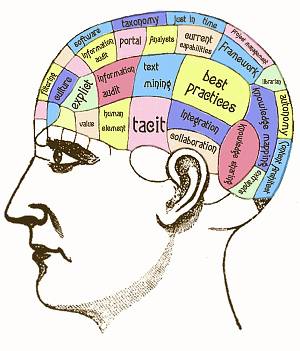
Phrenological Map
Academic education as internal phrenology.

On Langdon's definition of knowledge learning becomes the subjective fusion of information, theory, and experience. The student generates knowledge for himself by bringing information, theory, and experience into relation with one another. It isn't enough simply to have data; nor is it enough to see contextual possibilities; nor is it enough simply to have one or several experiences. All three must fuse within a single self-awareness, and the resulting knowledge possesses the breadth and depth only of the most limited of the three factors.

And perhaps most importantly for me, as an educator, on Langdon's definition of knowledge teaching becomes a creative attempt to stimulate and/or guide the student to meld the three ingredients of knowledge into practicable know-how. Successful teaching doesn't mean providing students with more or better information; it has to do with process only tangentially. Successful teaching means that students are, after being taught, measurably more effective in doing things. They get more done of what they want to do. It's hard to imagine students wanting anything else from their teachers--which may in itself be the strongest single argument for Langdon's definition.

10 December 2007

Sector four

A riddle: If you're not for-profit, and you're not non-profit, what are you?

"Ah..." says the clever reader. "You're the government."
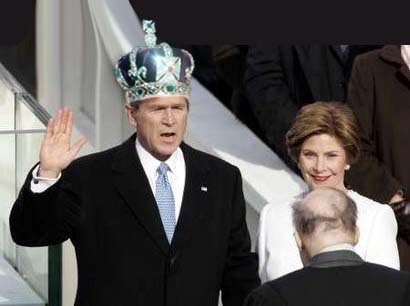
Bush Coronation
"But my lawyers tell me that I really am the government."

But let's just say that you're not the government either. (You listening, George?) You're still a private organization, you don't live off charitable donations, and you're not just in it for the money. Is there a fourth option?

There is. Although not fully formed, the emergent fourth sector comprises organizations not interested in playing by the old rules. Goodbye Marx, Spencer, Jacobs, and even Keynes. Hello KaosPilots. Increasingly referred to as "for-benefit," 4th Sector organizations have the following features:

  • Privately owned and controlled (not government)
  • Sustains its operations based on income generated by their activities (not a charity)
  • Returns some of their surplus to their equity owners in the form of profits (not a non-profit)
  • Leaves some of the value it generates in the community where it can continue to accrue (not merely a profit machine)

While for-benefit organizations often represent the fruit of social entrepreneurship, they're not one and the same. Social entrepreneurship (which has very official support here in Canada and elsewhere) means using the tools, techniques, and attitude of for-profit entrepreneurship to tackle social issues. For-benefits are one possible outcome of social entrepreneurship, but so are innovative charities, non-profits, political organizations, one-off events... even for-profits can be conscripted sometimes.

While no one knows exactly what the 4th Sector is going to look like, it's increasingly obvious that it's coming. (Even the last-to-every-party NYT has caught the shift in the wind.) And it won't be just companies--it's a whole new ecosystem. They're even growing their own venture capital firms. Watch out, old order.
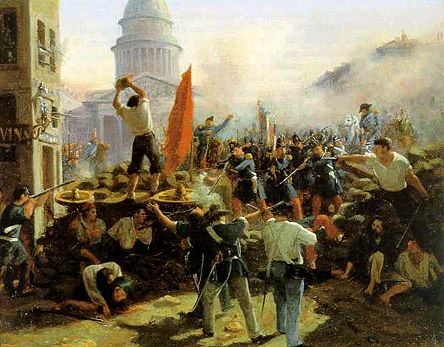
Vernet, Horace - Barricade rue Soufflot
"4th Sector rabble resists Ancien Régime forces?" No way.
"4th Sector overruns final barricade manned by scruffy Ancien Régime holdouts." Oh, yeah.

06 December 2007

Development of the slums, for the slums, by the slums

Shack / Slum Dwellers International (an organization which seems to take a Puckish pride in the lumpishness of its name) has undertaken a challenging mission: "Securing land tenure and housing" for the urban poor "in 24 countries on 3 different continents." Bold, but hardly original. Their approach, however, is another matter.

The group, known by the initials SDI and formed in India in 1996, is a loose network of grass-roots organizations of the urban poor. It’s grown to millions of members in 24 nations, cities spread from Manila to Cape Town, Mumbai to Sao Paulo. Typically, members are women ready to share their meager savings in collective efforts to upgrade their homes, secure titles to the land their houses sit on, build a latrine block, perhaps start a school.

Slum dwellers sit right across the table from local government authorities, designing projects and negotiating how they’ll be financed and carried out.
Of course, the slum dwellers get professional advice [.pdf], but we're talking about slum dwellers acting as their own real-estate developers. For themselves and on their own terms. And they just got an unrestricted grant of US $10M from the Gates Foundation.

Unbelievable? On the contrary: perfectly necessary. When governments, NGOs, and big businesses can't or won't get people what they want, people quite naturally just do it themselves. Although it's obvious, it bears repeating: the poor (like every other demographic) are their own best--and in many cases only--allies.

Caging the innovation bird

So, 800-pound Microsoft has begun developing a network of Innovation Centers around the globe as part of strategy to "to foster innovation and growth in local software economies." Hmmm....

I think most people would be at least a little suspicious of Microsoft's intentions in spearheading such an effort. Innovation is inherently a collaborative and not a competitive process. Microsoft claims to be cooperating with governments, universities, and other software companies; while I see no reason to think that they're not doing so, I do believe there are grounds for thinking that Microsoft may understand "cooperation" differently than some of its Innovation Center partners. Microsoft Founder Mr. Gates may or may not have reconnected with his inner philanthropist; it remains the case that Microsoft's behavior and corporate culture during his tenure was profoundly combative and territorial.

Soon every innovation in this neighborhood... will be mine!
(Photo by oddthingies)

A key question private businesses are asking themselves these days is how to capture value generated by an innovation process--how keep the innovation bird happy in its cage, as it were. Innovation, however, doesn't just thrive in an open environment--it arguably cannot even survive unless it can roam freely, build doors in impenetrable walls, outgrow its origins. While people can own innovation processes and products in the looser sense of taking responsibility for them, it's hard to see how anyone can own them in the stricter legal sense. (And I seriously, seriously doubt that Microsoft will be the one to crack this nut; their outlook is too closed.)

And if you've been wondering whether or not the new fixation on innovation is just a passing fad, it isn't. My ex-boss David Smith of the Affordable Housing Institute recently blogged about an April 2007 PNAS paper by Luís M. A. Bettencourt, et al., entitled "Growth, innovation, scaling, and the pace of life in cities." According to Smith, Bettencourt et al. divide all the factors of urban life into three categories:

  1. Factors that scale linearly with the city's size, such as number of jobs, water consumption, etc. (Smith calls these "personal matters");
  2. Factors that scale sublinearly with the city's size--i.e., those factors that enjoy economies of scale--such as consumption of energy and transportation resources (Smith calls these "hardware");
  3. those factors that scale superlinearly with the city's scale--i.e., those factors which enjoy network effects--such as disease rates, innovation rates, and wealth generation (Smith calls these "software," or "social interactions").
Wealth is, as Jane Jacobs has noted, an urban phenomenon. But wealth moves hand in hand with innovation--both are superlinear urban effects. Which means that big cities both demand and generate higher rates of innovation and wealth generation. Note that superlinear effects are not merely epiphenomena--that is, it's not just that bigger cities "happen to" generate exponentially more innovation, crime, wealth, and disease. The economies of bigger cities, when they grow (again, as Jacobs has noted), grow on the basis of wealth and innovation. An ever-growing economy producing ever more wealth--the holy grail of Protestant democratic capitalism--both requires and produces ever more innovation. As long as our cities keep getting bigger we will keep getting wealthier and smarter, and innovation will weave itself ever more inextricably into our economies and cultures.

As anyone who's tried to innovate knows, innovation relies upon creativity, and creativity thrives in open systems, open networks, and open minds. It's no wonder that the interests in innovation and social entrepreneurship have developed in parallel, since social entrepreneurs seem willing to perform all kinds of commercial functions without basing their organizations on the pathological greed and egomania which lie at the heart of corporate misbehavior. Greed and egomania are diametrically opposed to the values of generosity and humility which form the basis of every successful culture of innovation.

Corporations today--and Microsoft is no exception--want the wealth that follows on the heels of good innovation, but they can't bring themselves to believe that "proprietary innovation" makes about as much sense as "a happily caged falcon." At bottom, I think it's our whole notion of ownership which needs rethinking. In a sense, after all, wealth belongs to communities (or societies, if you prefer). We just entrust it to corporations and families and individuals in the belief that they will use it responsibly if their personal well-being depends upon its sound management. A pretty smart system, overall. But can we imagine (and design) a better one? Can we imagine (and design) a form of ownership which engenders and protects responsibility, but also resists the excesses of the miser and the tyrant?

Maybe building a better cage means not building a cage at all; maybe it means becoming falconers.
(Photo by wallyg)

03 December 2007

Responsibility in education

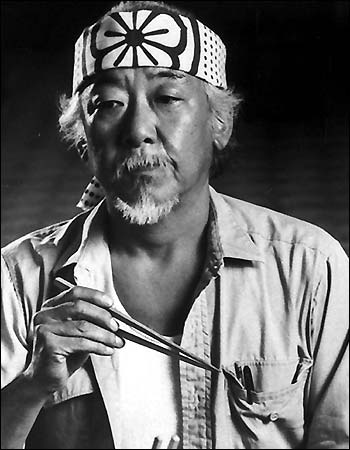
One of my personal favorite pedagogic precepts was best expressed by the laconic Mr. Miyagi, one of the all-time best teachers portrayed in cinema: "No such thing as bad student; only bad teacher."
Miyagi
"Man who catch fly with chopstick accomplish anything."

Which is not to say that even the most gifted teacher will enjoy success with every student. It's just that the most important lessons we learn from our teachers--how to face the overwhelming reality of human ignorance, when and how to (dis)respect authority, when to resort to knowledge and when to resort to compassion--derive not from what the teacher knows but from who the teacher is. That's because good teachers know that learning is not the process by which the student absorbs the teacher's knowledge, but rather the process by the student creates knowledge. The teacher can only either stimulate or suppress the student's personal learning process; or, put differently, what a student really gets from a teacher is an attitude, and if a student internalizes a (teacher's) bad attitude, then that student will find all future learning difficult.

Thus Bob Talbert's corollary to Mr. Miyagi's precept: "Good teachers are costly, but bad teachers cost more." So when I see failure in an educational context, I always look to the teacher (and his bosses) first.
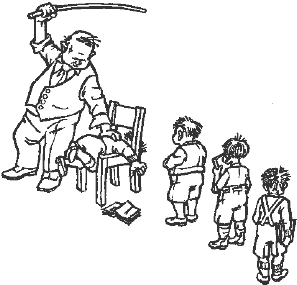
Corporal Punishment
Mr. Whipswitch could never understand why the other teachers kept ending up with the best students.

But it's not always that simple. Take the example of 14-year old Australian Beau Abela, who can barely read, let alone spell. He's in high-school, and has trouble counting beyond 10, so let's just set aside any questions you might have about his performance in algebra class. Beau suffers from a mild learning disability, so in some ways it's not surprising that his performance is subpar for his age, but this seems egregious. Indeed, Beau's condition--unless you're one of those all-too-common philistines who actually embrace incompetence--seems utterly outrageous. As in, it outrages me.

And I'm not the only one who's upset. Beau's father is suing the Victorian educational department for AU $300k. On the surface, seems like they probably deserve it. As you might expect,

Mr Abela [has] said his court action was not motivated by money, but by frustration at the way the system appeared to be letting down children. ... Mr Abela said he would drop the lawsuit tomorrow if the department would guarantee him it would educate (Beau) to a proper level.

I think most people can understand that Mr Abela is frustrated given his son's lackluster academic performance, but what exactly does he mean when says that the system is "letting down children?" Certainly the system doesn't seem to be producing measurable results in Beau's case. But to whom to attribute this failure? Or rather, how should responsibility for this failure be untangled?

Mr Abela concedes that
the Education Department had made significant efforts to help his son, including paying for one-on-one tutoring and providing a laptop. Over the years dozens of assessments and reports have been done to get to the bottom of Beau's problems. ... Documents seen by the Sunday Herald Sun show Panton Hills Primary School and Eltham High have directed considerable time and effort towards the troubled student.
What kind of problems, exactly?
Beau has been on ADHD medication in the past and school reports consistently say he does not concentrate in class or make an effort with his work. ... Eltham High School principal Vincent Sicari said in a recent report Beau's behaviour was increasingly disruptive and violent.
Doesn't sound like Beau's is an easy case. In fact, it rather sounds like the school system has been sensitive, proactive, and generous.

As framed by the Sunday Herald Sun, it looks as though Mr Abela is suing simply because he's frustrated--not because the school is at fault. And even if the school had been less responsive, how much (and what kind of) responsibility for Beau's failure could we honestly lay at the feet of his teachers and their bosses? How much (and what kind) belongs to Beau? Without more particular information on Beau's case, it's impossible to judge the case wisely.

But the very intractability of the case forces one interesting issue to the surface: Why do we persist in regarding education as a responsibility? Issues in contemporary education--especially failures--are almost always framed as a polarized conflict between individual responsibility and systemic sensitivity. The important question, as this line of thinking has it, is how much responsibility belongs to the student and how much to the system (as though responsibility only came in one flavor).

The key assumption which underlies this thinking is that education is a necessity, with all that that entails. And of course, education is necessary for the kind of society we operate [.pdf], the kind of culture we participate, the kind of government we practice. Indeed, few institutions bear more of the weight of our current way of life than universal education. The incredible social importance of education, however, tends to overshadow the fact that education provides (if these guys are to be believed) the most sublime pleasure available to human experience. It's worth remembering that our word school derives from the Greek skhole, which means "leisure"--school is supposed to be what humans do for fun.
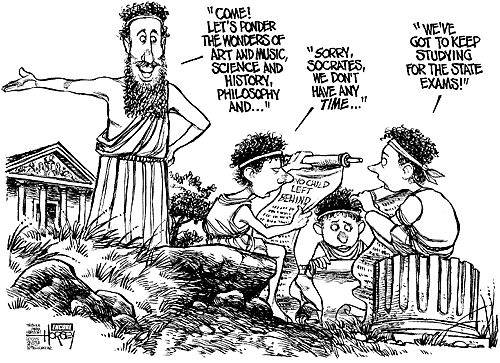
Exam-centric Studies
In a Protestant culture (and especially in a Puritan culture), even the pleasure of learning is suspect; only the pleasure of discipline passes without question--especially if the one disciplined is oneself.

Wait just a minute? Did I just say that learning is fun? Yes. That's it exactly. We often get so invested in the importance of "an education" (by which we too often mean "a decent résumé") that we forget that we can always recognize real learning when it happens because it is always pleasurable. (Incidentally, this is a non-trivial criticism of contemporary schooling, which is, as everyone knows, no fun at all. When learning happens in an academic environment, it's almost always either an accident or against the rules.)

So I have one question for Beau and his teachers: What does it mean that Beau is obviously having no fun at all "being educated" at Eltham High?

26 November 2007

Do values have value?

One of the most pernicious fallacies into which our business thinking is prone to fall--and this is especially true in disciplines like finance and engineering, where numbers are particularly preeminent--is the conflation of measured value and real value. It's an old truism that you cannot manage what you cannot (or do not) measure. But managers, driven by objective results, take it one step further: If we cannot (or do not) measure it, the thinking goes, then for all practical purposes we can act as if it were not real. Oh, the endless debaucheries which descend from this one, simple stupidity.
Measuring Love
Who says you can't measure love?

If we reject this fallacy, however, we ipso facto assume the value of CSR ("Corporate Social Responsibility"), which is really just another way of saying that the bottom line isn't really the bottom line. (Although, then again, maybe it is.) There are plenty of us who believe that environmental concerns, labor issues, management practices, and other corporate habits of thought and action impact the bottom line. Many of us also see quite clearly that making lots of money in our stock portfolio isn't worth it if the costs show up elsewhere.

Where else? Well, we might, I don't know, run out of water or something. (Even soft drink company execs, who seem to view potable water as competition, must realize that water is the main ingredient in their product.) Or perhaps canned air will become the only kind of air worth breathing. (Los Angelians must love the smell of cancer in the morning.) Or we pave our "path to financial freedom" using the backs of children. Or maybe we'll get to that point where corporate boneheadocracy seems normal.

After all, who cares? We customers and shareholders don't have to pay to clean up everything up when corporate America poops in the nest. But then who does? We taxpayers do, that's who. But wait. Aren't "customers," shareholders," and "taxpayers" just different roles played by the same flesh and blood human beings? Not only that, but at the end of the fiscal year, there's really only one balance sheet. Costs that corporate America manages to externalize just end up on a different line item on our annual budget, that's all. If we don't pay them as customers or shareholders, we pay them as taxpayers or family members or landholders or what have you. Only the dense, the foolish, and the psychopathic truly believe that the corporate bottom line is their own bottom line.

Burning Beds, Inc. has posted outstanding earnings for the past three quarters, and... hey! That's my bed!

Once you assume that clean water, clean air, happy children, and sane work environments have value (anyone other than these guys want to argue that this stuff is without value?), there are two possible ways forward:

  1. Get creative when it comes to measurement. Instead of whining about how some things are "unmeasurable," innovate new mensuration and valuation techniques. Two interesting actors in the field of valuation innovation are Innovest and Communications Consulting Worldwide (CCW). What's this all about? Consider the following example: Say Wal-Mart's got labor troubles (no, really, imagine it); how much does that dent in their reputation cost shareholders? According to CCW, "if Wal-Mart had a reputation like that of rival Target Corp., its stock would be worth 8.4% more, adding $16 billion in market capitalization." That's a game changing assertion, shifting the debate from "Can the effects of reputation be measured (i.e., is it possible)?" to "Can we improve the methodology used in this study (i.e., how well are we doing it)?"
  2. Stop managing and start leading. Insanity, as AA has it, is doing the same thing over and over and expecting different results. While the methods of bureaucratic management can optimize a banal system defined by quantified data, they are poorly suited to effecting metamorphic leaps in consciousness and/or character. As a rule, our businesses don't need to "do better," they need to "do differently." Better data and better management practices cannot provide a fresh, holistic vision for the future of business--only inspired leadership can do that. Bill McDonough and the Regenesis Group are two interesting players in the field of consciousness shifting.
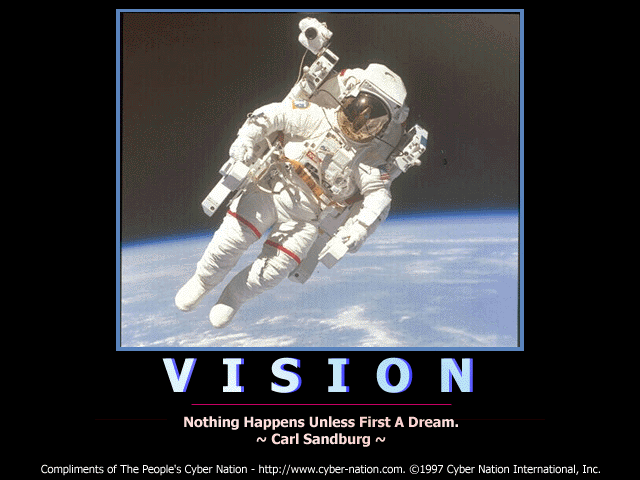
Vision (Cybernation)
We did not manage our way to the moon.

While I believe that creative mensuration and valuation techniques are effective tools for advancing a CSR agenda, they are useless without the proper outlook. Only competent, inspired leadership--a coherent vision supported by capable entrepreneurship--can truly change things. The incremental approach is appropriate as a rhetorical approach (that is, as part of a strategy of persuasion), but only a true leap in consciousness and character can ever save us from ourselves.