15 March 2009

Living through the digital revolution

Clay Shirky says more or less everything that needs to be said about why newspapers are in trouble and what might replace them in the future. He concludes:

In craigslist’s gradual shift from ‘interesting if minor’ to ‘essential and transformative’, there is one possible answer to the question “If the old model is broken, what will work in its place?” The answer is: Nothing will work, but everything might. Now is the time for experiments, lots and lots of experiments, each of which will seem as minor at launch as craigslist did, as Wikipedia did, as octavo volumes did.

[...]

Society doesn’t need newspapers. What we need is journalism. For a century, the imperatives to strengthen journalism and to strengthen newspapers have been so tightly wound as to be indistinguishable. That’s been a fine accident to have, but when that accident stops, as it is stopping before our eyes, we’re going to need lots of other ways to strengthen journalism instead.

When we shift our attention from ’save newspapers’ to ’save society’, the imperative changes from ‘preserve the current institutions’ to ‘do whatever works.’ And what works today isn’t the same as what used to work.

[...]

For the next few decades, journalism will be made up of overlapping special cases. Many of these models will rely on amateurs as researchers and writers. Many of these models will rely on sponsorship or grants or endowments instead of revenues. Many of these models will rely on excitable 14 year olds distributing the results. Many of these models will fail. No one experiment is going to replace what we are now losing with the demise of news on paper, but over time, the collection of new experiments that do work might give us the reporting we need.

As Shirky so astutely points out, the economic reality of newspaper publishing is shifting beneath the feet of the industry. Probably today's newspapers can't dance nimbly enough to save themselves. And that shouldn't worry us very much. It's just that one crucial function of newspapers--namely, reporting--remains a pillar of democratic society. We don't need to care who does it, but we need to care passionately that it gets done.

17 February 2009

The economists have no clothes

Over at The Atlantic, Gregory Clark admits, rather refreshingly, that academic economists have no clothes.

The current recession has revealed the weaknesses in the structures of modern capitalism. But it also revealed as useless the mathematical contortions of academic economics. There is no totemic power.
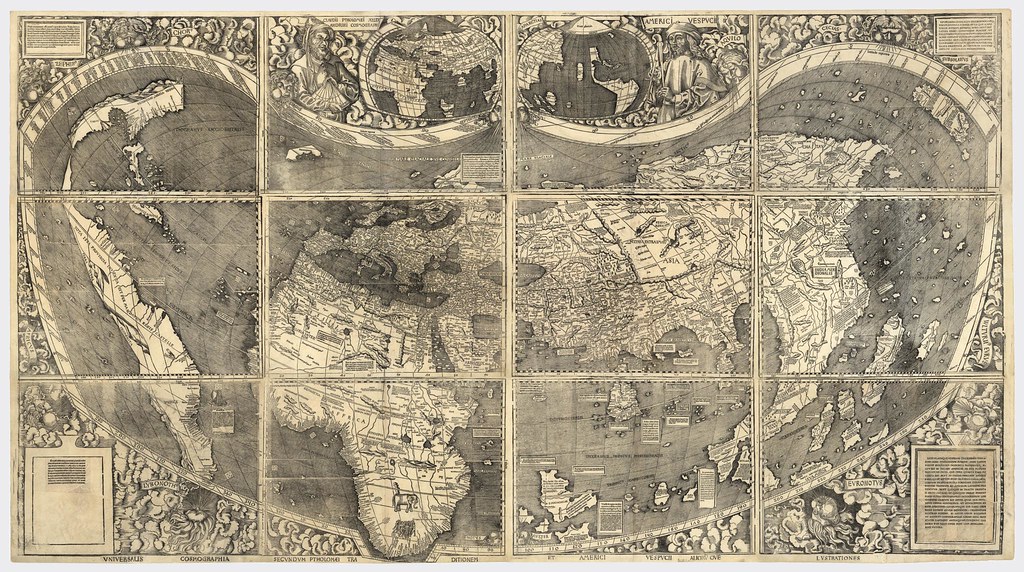
As a discipline, economics proposes models, which are by definition incomplete. That is, they exclude some details and highlight others. To think that economic theories actually describe reality--as opposed to offer an image of reality that is useful for some purposes--is to mistake the map for the world.
Waldesmüller, Martin - 1507 - Universalis Cosmographia
Ceci n'est pas le monde.

Further, the dismal science has all too often provided models whose validity is impossible to ascertain, since it has often built its theories on the basis of premises that are false prima facie. The point here is that, logically speaking, false premises do not yield false conclusions; rather, false premises render the truth values of an argument's conclusions indeterminate. It isn't that economic models are false, but rather that the falseness of their premises means that can know nothing with certainty about their conclusions. We can't say whether economic models are true, false, or some determinate mix of the two. Logically speaking, they're mere speculation, with the same logical status as wishful thinking.
Footprint Question Mark
You mean we came all this way and we don't even know if we're wrong?

For example, the theories of classical economics generally accept as axioms (i.e., they accept as true without argument) the following:
  1. All economic actors are rational.
  2. All economic actors have perfect information about the markets in which they act.
  3. All resources are scarce.
These are bad axioms, since they're obviously not true. As in, there's no doubt at all that these are false. Of course, not all branches of modern economics still accept these premises without qualification, but historically speaking these assumptions lie at the foundation of all economic thought. This is precisely the main reason I never studied economics in college. Who can take seriously a discipline that, wherever it ends up, begins with nonsense? While there's no doubt that the phenomena we think of as economic are intrinsically interesting, I remain skeptical that the formal discipline of economics has a great deal to offer beyond the obvious. As Clark notes:
The debate about the bank bailout, and the stimulus package, has all revolved around issues that are entirely at the level of Econ 1. What is the multiplier from government spending? Does government spending crowd out private spending? How quickly can you increase government spending? If you got a A in college in Econ 1 you are an expert in this debate: fully an equal of Summers and Geithner.
Common sense cloaked in jargon and equations. Even the economists' invisible clothes look rather shabby these days.

23 September 2008

The value of inconvenience

By almost any meaningful performance measurement, the U.S. economy in the 20th century performed better under Democratic administrations than under Republican ones. Reflecting on this seeming paradox, Christopher Carroll suggests that

perhaps the best explanation has to do with attitudes, not doctrines: Maybe capitalism works better when its excesses are restrained by skeptics than when true-believers are writing, interpreting, judging, and executing the rules of the game. (The Democrats are surely the more skeptical of our two parties).
Most would agree that restraining the excesses of almost anything counts as good sense, but this is only a preliminary step toward a bigger and more interesting idea:
Capitalism works better when it is being held accountable to some external standard than when left to its own devices.
The whole system works better when "held accountable to some external standard," when it is, in a word, constrained. Optimal performance, in other words, is the fruit of struggle. Make things too easy and performance declines.
Easy Living
Relaxed external standards? Check. Highlight reel material? Not so much.

Consider how effective coaches pull outstanding athletic performance from their players. Good coaches don't let their players do whatever they want, without accountability or oversight; they create rules and systems of accountability. A good soccer coach makes you use your weak foot in order to develop it. A good swimming coach pushes you to hold your breath longer. Optimal athletic performance depends upon the measured application of psychological and physiological pressure. (Go watch Gavin O'Connor's Miracle to see a dramatization of great coaching.) Good coaches don't remove limitations--they use them.

Or consider architectural and industrial design. The famous designer Charles Eames (yet another famous St. Louisan) once remarked:
Design depends largely on constraints.
We tend to believe that creativity is best served by removing constraints. If we could just somehow make the process of invention easier for the inventor, we imagine that she would be more inventive. But the opposite is usually true. People get creative--truly creative--when challenged to negotiate constraints. Budgets (within reason) push architects to develop new strategies to solve old problems. (The story of how the design of Seattle's new public library building developed is a great example.) The particularities of manufacturing processes push industrial designers to find solutions which challenge convention. (The story of the how the first commercially viable computer mouse was designed is a textbook example.) Constraints drive creativity.
Goldsworthy Boxed Tree
Artist Andy Goldsworthy creates astonishing ephemeral works using only the materials he finds on site during his wilderness hikes: creativity driven by constraint.

The same is true in business. Real innovation happens where someone discovers a new way to scratch an old itch, where someone thinks through a problem in a new way (even if it's simply a new application of an old technology). When we talk about innovation happening "at the edges" of a market or industry, what we mean is that innovation happens where business rubs up against constraints. (The "mainstream" of anything is where things flow smoothly, right?) We can't have innovation--and capitalism's greatest strength as an economic system is its powerful incentives for innovation--unless we have the right kind of rules and restrictions. (The question of "more" regulation versus "less" regulation is puerile. The kind of regulation matters more than the amount.) The free market, to put it pointedly, is only as free as its constraints force it to be.

Of course, constraints are damned inconvenient. And that's precisely the point. It's often--if not always--in response to inconveniences that people are most creative, most inventive, most innovative. And so we're led inevitably to the conclusion that inconveniences can be useful.
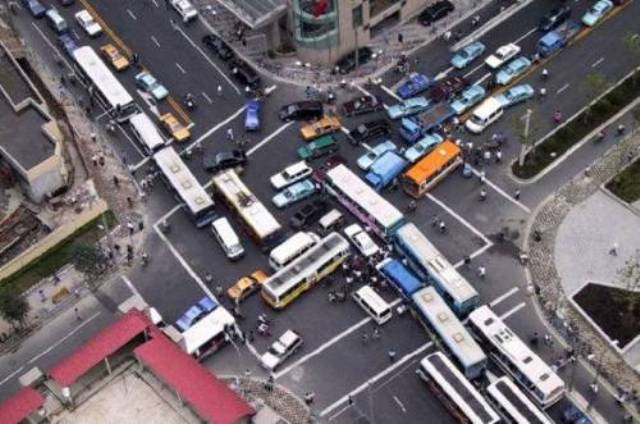
Gridlock
"Traffic lights are just the Man keeping us down! We will not be constrained!"

Some inconveniences, naturally, are more useful than others, but that hardly obviates the necessity of inconvenience for optimal performance. It's easy enough to see how inconveniencing others might be worthwhile, but it's one of the marks of emotional maturity to see the value of inconvenience for oneself. Politics--in the largest possible sense of the word--is only possible because we deliberately accept to be inconvenienced in certain ways (e.g., we don't simply use whichever car is closest, use guns to force our crushes to go out with us, or lynch elected officials from opposing parties). We recognize that our condition is collectively better when we all accept to be inconvenienced in certain ways. (Again, the kind of self-regulation matters more than the amount.)

Finding--and enforcing--the right kind of constraints is key to getting the most out of people, as innovators, as politicians, as artists, as designers, and even as citizens. We would all of us do well to remember that inconvenience--yes, even our own--often serves us much, much better than convenience.

10 July 2008

The first rule of student engagement

I'm in Québec City right now, attending a 5-week intensive program in French Language immersion. One of the options I've chosen is an introductory survey course on Quebecoise literature. There are only a dozen students in the course, so the teacher said she'd like to run the class more as a seminar and less as a lecture. Which sounded great--but it turns out our teacher doesn't seem to know how to run a discussion (not an uncommon failing among teachers). She doesn't seem to grasp the first rule of student engagement--actually, the first of intellectual engagement in general. And that rule is this:

People engage with ideas on the basis of what they already know.

The technicalities of revolution are, as everyone who attended the party found out, pretty damn tedious.
(Revolutionary Tedious Party, originally uploaded by abitnice)


This rule has two important practical corollaries:

  1. Discussions turn on questions that everyone can answer. Domains where students are largely ignorant offer no footholds for students to establish a stance and launch into a discussion. If you start talking about what you know well, but what your students don't know at all, they won't respond for the simple reason that you're the obvious authority and what you say goes. If you base the discussion in a domain where the students have some knowledge (their own opinions are painfully dependable as a point of departure), you'll be able to introduce the topics you want to cover without killing the conversation.
  2. Technicalities kill engagement. Technicalities are inevitably the province of specialists. If you're talking about technicalities, you'd better be talking to another specialist (or someone who aspires to be a specialist). If you're not, guaranteed you're boring people in a way that makes them just want to break something.
Engagement is the foundation of every learning experience. Engagement can only happen when people take what they already know and either reinterpret it or connect it with new knowledge.

28 March 2008

A cinema whose house is always full

As promised, I'm getting around to posting my better business ideas. Yes, yes. I'm sure your breath has been bated.

INTRO
Think of your favorite movie. Now imagine the ideal environment in which to watch it. Do you see yourself alone, in your underwear, in your own bedroom, late at night, watching your favorite movie on your computer monitor? Unless you're one of those rare individuals willing to argue the artistic and cultural merits of porn, it's not likely.
NOT the Future Cinema
The future of porn? Maybe. The future of cinema? Don't count on it.

Probably you're thinking of a dark room with a huge screen and comfortable chairs. And, almost certainly, other people. Although the advent of forums like YouTube has fomented whole new genres of minimalist movies (e.g., machinima, video how-tos, porn vlogs, and even as yet un(sound)bitten political speeches), our thirst for full-length feature films appears unslaked. And we still prefer viewing them, when possible, in the company of other viewers. As an art form, film descends from theater, and the social dimension of theater is irreducible and ineradicable. Part of the meaning of watching theater--and therefore part of the meaning of watching films--is watching them as part of group.

Viscerally, we know this is true. Funny movies are funnier when viewed in a packed cinema. Scary movies are scarier. Exciting movies are more exciting. The whole experience of watching a film is intensified and improved when the house is full.
Meunier, A. - 18th C. - Paris_ Comedie Francaise
In a sense, "audience" is a role--a role it sucks to have to play by yourself.

OPPORTUNITY
Most current thinking about about how people are going to consume movies in the future, even the freshest, can be divided into models based on how people consume live theater on the one hand and how people consume internet pornography on the other. (There are some non-stupid "innovations" in the works which try to make the most of the cinema space, but they have little to do with the movie-going experience per se.) The theater model can't seem to get past the fact that plays are performances while films are recordings of performances--that is, they're what we call media. The porn model can't seem to get past the fact that watching anything except porn by yourself isn't nearly as much fun as watching it as part of an audience.

The most important development in the movie business during the past 20 years isn't--with all due respect to Peter Jackson and his fanboys--CGI, but the megaplex:

The improved viewing experience and the ability to let consumers watch whatever movie they wanted almost whenever they wanted brought more people through the door and bulked up Hollywood's grosses.
I love this conceit--that access to 20 or 30 screens has allowed consumer to "watch whatever movie they wanted almost whenever they wanted." Whatever movie I want? Give me a break. And what about TV series, animated shorts, foreign releases, etc. etc. etc.? And rental stores? There are good reasons why they're dying out.
Local Video Store
"Um.. Bollywood? The Thunderbirds? Fullmetal Alchemist? Le Dîner de cons? Nah, we don't got any of that. But, dude, have you seen The Transformers?"

Megaplexes offer an order of magnitude more choice than the 3-screen movie house; your average rental store (which carries some 3,000 titles according to Chris Andersen) ups the choice by two more orders of magnitude. And then Netflix and company bump that up to 60,000+ titles--another order of magnitude plus a doubling thrown in for good measure. No doubt that 30 screens offers a lot of choice, but it's still the film industry and the theater managers who decide what's on the menu. Time to break out.

THE IDEA
The challenge, I would argue, is to get The Long Tail of screenable media (i.e., movies, TV, video games, and a bunch of stuff I'm sure I'm missing) to interface elegantly with the social theater experience.

The Setting. So, imagine an urban megaplex which offers 30 screens of varying sizes--from the 300-person stadium to the 15-person black box. (I'm picking 15 as the minimum capacity because, in my experience anyways, 12 is the magic number where dinner party tips and becomes a house party.) However we manage it, our megaplex is technically capable of showing anything that's currently out on DVD on any of its screens. (I see two basic possibilities here: either (1) allow the viewers to bring their own media--you're just a screen and seat provider; or (2) go digital--maybe make ISO images of every DVD you can get your hands on, or an equivalent. I like (2) better for a variety of reasons, but (1) might be the place to start while the IP agreements get hammered out.)

Architecturally, the lobby resembles a cafe more than a cattle yard. Picture a large space subtly divided by differences in floor height, floor coloring, lighting, etc. in order to create a cluster of distinct, yet interconnected spaces, each of which feels somewhat enclosed and therefore intimate. The idea is to provide environmental level support the social dimension of consuming screenable media. Film clubs, groups of friends, and/or couples can use this space to nosh and chat before and after movies.

The Website. The website of our megaplex looks more like a social networking website than a tarted-up broadsheet for the very simply reason that it is a social networking site. The website is the platform which our megaplex uses to decide--on a rolling, ongoing basis--what it's going to show on each of its screens. Website members "vote" for a particular title and a particular time-slot by prepurchasing tickets to those titles at those times. (Credit card authorization--not charged until movie is shown.) The most popular title for any given time-slot is shown in the biggest theater, the second most popular in the second biggest screen, and so on. Titles are "locked in" 48 hours in advance in order to allow everyone to plan their schedules and casual viewers to pick what they want.

One interesting consequence of this system is that it becomes possible to distribute various screens over several different physical locations within a city. Not too many different locations, or people would get confused. But a single web system could link together a handful of physical clusters of screens into a single movie selection and viewing system, effectively allowing our megaplex to consume urban real estate much more efficiently. We can therefore offer 100 screens' worth of choice without thereby incurring a need for a gargantuan, unbroken chunk of real estate. In fact, precisely the opposite. The more geographically concentrated our demand (the more "urban"), the more screens we can offer. And further, since every theater is filled to capacity (or as close as we can get) every time, we optimize our use of square footage even further.

Show Me the Money. Our megaplex will pass profits back to those who own the rights to the media on a per-seat-sold basis rather than a per-showing basis. This has several consequences.

First, pricing for the viewer is dynamic. The more "votes" a suggested title-and-time gets, the cheaper the tickets. This displaces some of the responsibility (and risk!) of promoting a particular title-and-time onto its supporters. A film club working its way through all of Humphrey Bogart's films, for example, will not only form the core of the audience which views those films--they'll also promote those title-and-times to everyone else. Take this line of thinking to its logical conclusion, and you've got individual promoters buying out entire screens and promoting film events (say, a Star Wars-a-thon) on their own. The promoters shoulder the risk of promotion; the audience gets a full house experience; and our megaplex gets a locked-in profit on an optimized use of cinema square footage. Every title which gets shown in our megaplex has, before it shows, demonstrated that it can command such-and-such level of committed demand.

Second, pricing between our megaplex and media rights owners is negotiable on a title-by-title basis--even on a showing-by-showing basis--because our megaplex can show exactly how many seats are sold for each title. Structurally, such a system will favor older titles (whose production costs have already been either recouped or written off), niche titles (which capture focused, sustained affection), and less publicized titles (which have fewer advertising costs built into their financing model). Basically, although our megaplex is perfectly capable of competing with "normal" theaters when it comes to blockbusters, it's capable of making gold out the vast libraries of screenable media currently lying around in our culture.

And third, this system really opens up the possibilities for using a cinema-like space in creative ways. Business presentations? Naturally. Ungodly-huge-screen Super Smash Bros. Brawl parties? No problem. Anime marathons? Duh. In a way, this model is a bit like McDonald's:
The brilliance behind Harry Sonnenborne’s model [for McDonald's] was to sell real estate and not hamburgers. His suggestion was to purchase or lease the land on which all the McDonald’s restaurants were built on. Franchisees would then pay the company either a monthly rent amount or a percentage of their gross sales, whichever amount was greater.
The idea isn't to sell movies (which today's theaters can't do, so they sell outrageously priced corn syrup instead) , it's to rent square footage, facilities, and equipment to those in a position to use those resources to their utmost. Why be a lousy movie promoter or a gouging snack-food vendor when you can be a fantastic screenable media landlord? Let the watchers be the deciders, because those who decide what to show bear the risk for promoting it.

AFTERWORD
There are plenty of holes here, so please, comment away.

06 March 2008

The Meaning of Business

Lately, I've been mulling over a comment made by my uncle--who has the reputation in the family of being a super savvy investor--to the effect that it doesn't matter what a business does per se, so long as it turns a profit. I've argued before on this blog that my uncle's position unfairly impoverishes the concept of value. I've even gestured (crudely) in a few directions which might help us to enrich our concept of value.

Over at The Bastiat Society Blog, however, Ben Rast has a post entitled Business as Creative Act, which takes the first few steps down what I think is the brightest path toward a full and mature understanding of what business is (and why my uncle is mistaken). Simply put:

Business, as a creative act, draws on the very same strengths and suffers the same weaknesses as the creative act in art. They are more alike than dissimilar.
By "creative act," Rast means to emphasize entrepreneurship particularly:
We can illustrate just how much artistic creativity and business creativity have in common with the following paragraph of advice to writers, taken from an interview of William Faulkner published in the Paris Review in 1956:

"Let the writer take up surgery or bricklaying if he is interested in technique. There is no mechanical way to get the writing done, no shortcut. The young writer would be a fool to follow a theory. Teach yourself by your own mistakes; people learn only by error. The good artist believes that nobody is good enough to give him advice. He has supreme vanity. No matter how much he admires the old writer, he wants to beat him."

Now, notice how well it works as advice to entrepreneurs -- those troublesome dreamers and innovators in business -- with a few strategic substitutions.

"Let the entrepreneur take up surgery or bricklaying if he is interested in technique. There is no mechanical way to get business done, no shortcut. The young entrepreneur would be a fool to follow a theory. Teach yourself by your own mistakes; people learn only by error. The good entrepreneur believes that nobody is good enough to give him advice. He has supreme vanity. No matter how much he admires the old business, he wants to beat it."
Rast is astute to catch this similarity. People who launch new enterprises resemble artists in their drive to make something new, to add an original trope to the poem of humanity. But it's obvious, in a sense, that entrepreneurs are creators. What's not so obvious is that all productive activity (in the economic sense)--that is, all business activity--is creative as well.

To put it succinctly, human creativity is coextensive with human endeavor. Wherever people get stuff done, there people come up with new ways to think, do, and make. It doesn't matter what you call the end product--good, service, artwork--productive human activity demands creativity for the very simply reason that every object humans make with intention and every action humans do with intention bears the stamp, as it were, of the intention that brought it into being.

Aristotle identified four causes which obtain in the world: the material, the formal, the efficient, and the so-called final cause. It's the last one which concerns us here. The
final cause explains the cause of something in terms of its conceived end, or the purpose why it is made. According to Aristotle, [the] final cause is “the end (telos), that for the sake of which a thing is done.”
Every good is made and every service performed for the sake of something else--specifically, they're made and performed for the sake of the customer's good. That's why we call them "goods," right? Yes, yes, the producer produces goods in order to get paid, and the service provider serves in order to get paid, but they only get paid if someone recognizes the value of their goods and services. (And this objection is weak, since money is only and always a means to an end. "To get paid" can never be a final cause for making or doing something for the simple reason that money always points beyond itself to another end--one always exchanges the money on something else. It is not, simply put, final.)

Because goods and services are self-evidently intended to do someone some good (otherwise who would buy them?), we can say that economically productive activity is not only a functional activity, but is additionally an expressive activity--that is, it means something. In particular, it speaks to a vision of the good in general and the customer's good in particular. Even further, each good produced and each service provided changes the world; each good and each service brings into being a new state of affairs which must be presumed to be better than had the good been left unmade, the service undone (again, otherwise who would buy them?).

From this line of thinking two absurdly important conclusions follow:
  1. Businesses really do change the world--so they'd better get it right. The presumption of "providing value," of making or doing something "good," is built into the very possibility of business. If a business doesn't add value--that is, if it doesn't make the world a better place--then it has no business being in business. It seems almost too obvious to need saying, but... businesses may be judged by the same standard as every other human endeavor, and that standard is whether or not the business's making and/or doing makes the world a better place.
  2. Investors are to companies what patrons are to artists--so they'd better get it right. Warren Buffet famously advises investors to buy shares of a company only if they'd be willing to buy the whole company. I'll take Mr. Buffet one step further. You should buy shares of a company only if you'd be willing to be that company's sole customer--like an artist's patron, buying, owning, and enjoying responsibility for that company's entire output. Just as being a shareholder means being wholly and individually responsible for (and dependent upon) a company's entire financial performance, so being a shareholder means being wholly and individually responsible for (and dependent upon) a company's entire, world-changing making and doing. Just like a patron, you've put money down so that the companies you own can make what they make, do what they do. You enjoy the financial fruit of the shares you own for the single, simple reason that the companies you own get paid for changing the world, and the world they're making and enacting is the world we all live in--the world our children are growing up in.

07 February 2008

18 inspirations for educators and social entrepreneurs

Some people collect stamps. Others collect curiosities. I collect (among other things) pedagogical models, theories of learning, writings on education, and great educators. Someday I'll boil it all down and give you just the bullion, just the essence. But I need more time. My collection is far from a complete 7-course chowdown; heck, it won't do anything more than whet your appetite... but at least that means I've probably gotten to hors d'oeuvre status.
Vincent, Levin (1658-1727) - 1719 - Elenchus tabularum...1
"My! You have such an interesting collection of... um... what are these, exactly?"

Model Institutions, Organizations, Etc.

  1. Danish Folkeuniversitetet ("Folk High Schools"). The keystone of Danish national and democratic identity. One of the great triumphs of modern liberalism (in the strict sense of the term).
  2. Hampshire College. The Un-Ivy League. Classes, but no core curriculum. Written evaluations, but no grades. Books, but no teacher's dirty looks.
  3. The Nueva Escuela ("New School"). A program aimed at the developing world which supports schools as agents of positive social change. Focuses on education which is "active, participatory, cooperative, child-centered, and life-relevant." The story is that the founder asked every Nobel laureate she could get her hands on what kind of school they wished they had attended.
  4. The KaosPilots (of course). A new kind of business school, aimed at at the fourth sector.
  5. The Acton MBA (of course). Business school on steroids, which aims to produce entrepreneurs rather than managers.
  6. Y Combinator. Although it claims to be a new kind of venture capital firm, it's really an intense education in how to be a world-class tech entrepreneur.
  7. Gever Tully's Tinkering School. Let your kids do dangerous things, otherwise they'll never learn how to handle dangerous things. When I put it that way, it's obvious, right?
Writings Worth Reading
  1. "On Education." Ralph Waldo Emerson's seminal essay on the subject, in which he argues that "the secret of education lies in respecting the pupil."
  2. "Talks with Teachers." Brilliant lectures on teaching by eminent 19th century American psychologist and philosopher William James.
  3. "Complicity." Online journal on complexity (read: chaos theory) and education. Be warned: this journal has a rather pointy head.
  4. Infinite Thinking Machine. A blog providing coverage of innovation in education.
Models, Movements, and Technologies
  1. Ignatius of Loyola's Spiritual Exercises, by which I mean more than simply the book by the same name. The exercises are a masterfully conceived and carefully refined ethical technique (read: a practice by which one acquires a particular character).
  2. Unschooling. Let the child set the educational agenda; teaching consists principally in encouraging and enabling.
  3. Moodle. A widely used open source course course management system.
Educators to Emulate
  1. Socrates. The gadfly of great Athens.
  2. Johan Amos Comenius, the Czech (Moravian, to be precise) "Copernicus of education."
  3. Nikolai Frederik Severin Grundtvig, founder of the Danish Folk High School.
  4. Amos Bronson Alcott, the original Transcendentalist, and the greatest teacher [.pdf] in U.S. history.